
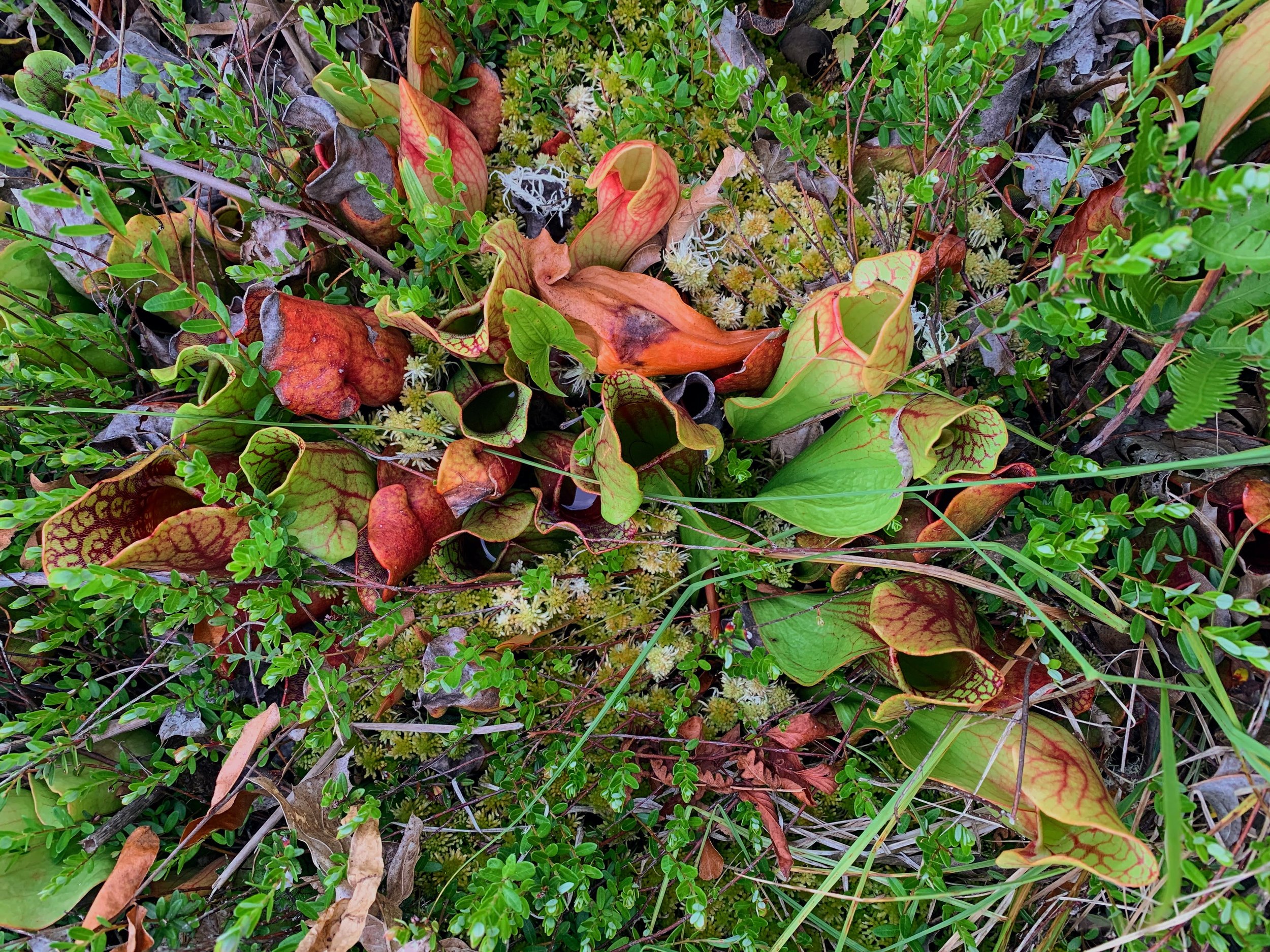
Research
Click into each item to explore.
-
nytimes.com/interactive/2022/05/05/headway/scotland-peatlands-climate-change.html
On non-Scottish investors buying up huge tracts of land for carbon offsets. I am keenly interested in how land is valued. Peatlands, and in Scotland bogs in particular, have been widely regarded as wastelands waiting to be drained or harvested and converted to agricultural land. Even when “conserved,” until recently they were often planted with trees, which of course were highly unsuccessful because of the high water table and acidity. Now, the spectre of a profitable carbon offset market is driving up the price of rural land, making land ownership even more inaccessible to local people.
Scotland has the most unequal land ownership in the global north, and after English victory and the Highland clearances in the 1700s, more than half of Scotland’s land was foreign-owned. I was frustrated by the way the article described this: “when estate holders repurposed their land.” This was the period after a Scottish rebellion when clan life was destroyed, land was taken, people were forcibly displaced, scottish gaelic was outlawed and actively supressed, the wearing of traditional cultural dress was outlawed, and so on.
See also:
Reuters: Who owns Scotland?
Prospect: Who really owns Scotland?
and others.
-
This book is extremely wide ranging and is the sequel to his book 1491, on the Americas just before colonial contact. I highly recommend both books.
For this project I drew from pp. 51-151, on the Atlantic coast and “evil air”.
Mann describes the powerful role that ditching and dyking wetlands (obstructing the natural movement of water in order to make the land arable) had in the increase in malaria in SE England because of the enclosures in the 1600s, which provided new motivation to make wetlands productive and profitable.
The early British colonists not only brought malaria with them to America, they also created ideal conditions for malaria to explode, with the way they engineered the landscape for tobacco growing.
Mann’s accounts were the first that I came across connecting the dots of the "bad air" that bogs were widely considered to have and the way wetlands became hotbeds of malaria due to landscape engineering for crop production.
"Malaria" is Italian for "bad air," and both in England and english-speaking America bogs became deeply identified with sickness.
Vintage Books, 2012.
-
Bruno Latour's lifelong project was to interrogate and disrupt the nature/culture divide that is the foundation of modernity. The depth of this conceptual divide is important for grasping the extractive and descructive orientation western civilization has toward the web of life. Latour's work has been fundamental to my thinking about this divide, and also because of his understanding of the importance of art-making for serious intellectual inquiry. See also his book We Were Never Modern and Reassembling the Social.
Translation by Catherine Porter, Polity Press, 2017.
-
Struzik, a canadian science journalist, is extremely readable, informative, and delightful. Evocative nature writing that makes me want to visit every place he writes about.
I drew from every section of this book, but particularly the chapters on the Great Dismal Swamp, pp. 27-54, and Central Park, pp. 55-70, which is where he talks in more detail about the association of bogs and swamps with miasma and disease.
Island Press, 2021.
-
If you haven't read Kimmerer, stop what you're doing and go find a copy. Her work integrating scientific and traditional ways of knowing is beloved for good reason.
I particularly love the audiobook version, narrated by Kimmerer herself. Her poetic attention and love for her subject matter, her patience and enthusiasm as a teacher, and her soft, motherly voice is a balm and an inspiration.
I particularly used the introduction and the chapter on shagnum, “The Red Sneaker” pp 111-120.
Oregon State University Press, 2003.
-
British writer Robert Macfarlane collects words and names—rich traditional vocabularies describing the details of the land and humans' lives with it.
“Once they [natural phenomena] go unnamed, they go to some degree unseen. Language deficit leads to attention deficit” (24). “Once a landscape goes undescribed and therefore unregarded, it becomes more vulnerable to unwise use or improper action” (27). “It is precisely what is invisible in the land that makes what is merely empty space to one person, a place to another” (quoting Yi Fu Tan, 29).
MacFarlane reminds us that “place-speech serves literally to en-chant the land—to sing it back into being, and to sing one’s being back into it.” (22).
In chapter 2, he tells the story of an island community in Scotland that came together to protect its local bog from destruction because they had a relationship with their place, pp 15-36. He shares a glossary of words from Gaelic, English, and Welsh relating to bogs on pp.37-54. These words are indigenous to their places, emerging from culture-on-land, reminding us yet again that nature and culture do not need to be considered two poles at odds from one another, as they are in modernity.
Penguin Random House UK, 2015.
-
Some of Annie Proulx’s research in this book seemed incomplete and contradicted things I had learned elsewhere, and I found her style abrupt and disjointed. But, I really appreciated her deep research into the history of the destruction of the fens in SE England, and I learned quite a bit about bog bodies in this book.
Scribner, 2022.
-
Go for the episode on bog butter, stay for the trove of Scottish folk tales, mythical beings (some boggy!), traditions and history.
I learned a great deal from this podcast, and it brought my son and I a lot of joy when I was missing our former home.
-
-
This is a very cute and helpful intro to peatlands and how they store carbon! A great place to start.
My only comment is that they only mention the bog's wetness to explain why things don't decompose in bogs. Bogs’ wetness is particularly anaerobic, highly acidic, and has additional chemicals from the sphagnum, which is why an object’s decomposition in a bog is very different than, say, at the bottom of a lake.
February 2022 by Sabrina Imbler and Eden Weingart
-
The indispensable field guide, with ethnobotanical notes.
Lone Pine Publishing, 1994. 2014.
-
Check out their "Strategy for Responsible Peatland Management" and online journal "Mires and Peat."
Harvesting peat is still big business.
-
-
Their website is extremely helpful as a field guide and for ethnobotany.
-
Seattle Audobon Society, 1997.
Out of print, extremely helpful. I accessed a copy at the University of Washington library.
-

Part of my process with this project involved auditing a class, “Anthropology of Science,” at Reed College. Since I don’t have a cultural or traditional relationship with bogs, one of the main avenues for me to pay attention and engage with bogs is to learn the science.
I had a lot of mixed feelings about this. Could I honor and learn from these beings using a knowledge system that doesn’t accept indigenous knowledge systems or those based in different values or non-western cultures? A knowledge system that only became interested in wetlands after noticing some of the knock on effects of their widespread destruction? (see for instance https://www.fws.gov/sites/default/files/documents/Wetlands-Losses-in-the-United-States-1780s-to-1980s.pdf)
The readings and discussion helped me gain context and critical understanding of how and why science came to be what it is, how it functions, and how within a very narrow range of parameters and questions, it can produce more, and more specific, knowledge than perhaps any knowledge system before it. I learned about the values at play in the development of the discipine and about why it is not able to gauge morally what questions are valuable, or what ecosystems are valuable. It is only able to value what produces knowledge that it can measure. Some of the texts that were important to me are listed below:

-
It all begins with an idea. Maybe you want to launch a business. Maybe you want to turn a hobby into something more. Or maybe you have a creative project to share with the world. Whatever it is, the way you tell your story online can make all the difference.
-
It all begins with an idea. Maybe you want to launch a business. Maybe you want to turn a hobby into something more. Or maybe you have a creative project to share with the world. Whatever it is, the way you tell your story online can make all the difference.
-
It all begins with an idea. Maybe you want to launch a business. Maybe you want to turn a hobby into something more. Or maybe you have a creative project to share with the world. Whatever it is, the way you tell your story online can make all the difference.
-
It all begins with an idea. Maybe you want to launch a business. Maybe you want to turn a hobby into something more. Or maybe you have a creative project to share with the world. Whatever it is, the way you tell your story online can make all the difference.